

When do the texture and appearance of hair return to “normal” after chemotherapy?
Biological, molecular, and clinical analysis — and the crucial role of the RENASCOR protocol**
1. Introduction: post-chemotherapy regrowth, an unknown biological phenomenon
Hair regrowth after chemotherapy is often described as “unpredictable,” “abnormal,” or “disappointing.”
However, these observations are not random: they reflect the deep state of the hair follicle, severely disrupted by cytotoxic agents.
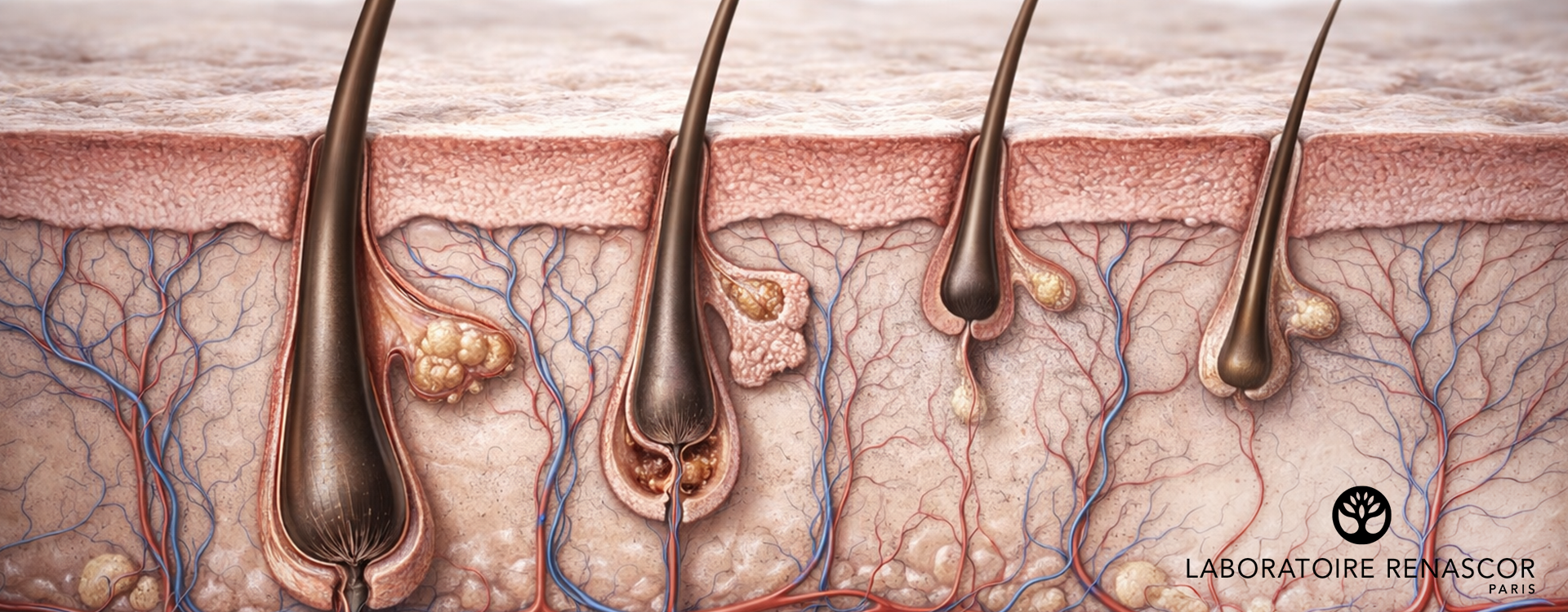
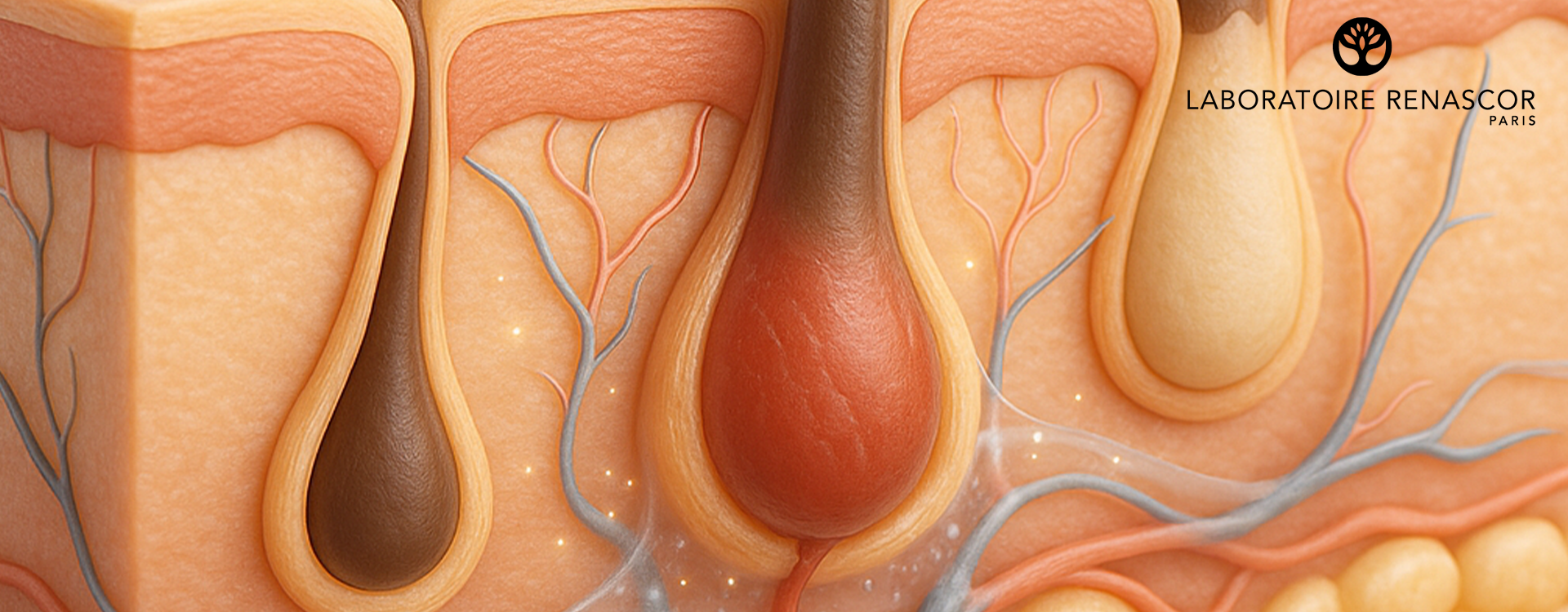
The follicle is a complex biological structure, highly vascularized, extremely active metabolically, and whose functioning relies on a precise orchestration between stem cells, keratinocytes, melanocytes, follicular sheaths, and microcirculation.
When this system is damaged, the hair cycle loses:
-
its synchronization,
-
its normal keratinization capacity,
-
its internal structural cohesion,
-
its stable pigmentation.
That is why the hair that regrows after chemotherapy is:
-
curlier,
-
drier,
-
duller,
-
less dense,
-
thinner,
-
sometimes colorless or different from the original hair.
This phenomenon is not cosmetic:
it is biological, molecular, and predictable.
2. Why chemotherapy deeply alters the follicle: scientific explanation
Chemotherapy agents target highly proliferative cells.
The hair follicle is one of the most biologically active human tissues:
matrix keratinocytes divide faster than the majority of cells in the body.
Thus, chemotherapy:
-
massively destroys matrix keratinocytes,
-
disrupts bulge stem cells,
-
damages the dermal papilla,
-
induces a persistent low-grade inflammation (IL-6, IL-8, TNF-α),
-
reduces microcapillary vascularization,
-
disorganizes the internal (IRS) and external (ORS) sheaths,
-
alters melanogenesis,
-
disrupts keratinization.
The direct consequence:
The follicle, still traumatized, produces a hair fiber immature, irregular, fragile, and dysfunctional.
3. Why “classic treatments” (castor oil, argan, coconut, plant oils) are ineffective, and are just placebos
These products are applied on an epidermis seeking solutions to a cellular problem, or on the hair shaft.
However, the shaft is a dead material, devoid of metabolism.
No external treatment, even natural or nourishing, can:
-
restore the follicular matrix,
-
reduce bulb inflammation,
-
reprogram the stem cells,
-
rebuild the sheaths,
-
normalize keratinization,
-
reinitiate melanogenesis,
-
stabilize the anagen cycle,
-
densify the dermal papilla,
-
restore functional vascularization.
These are cosmetic treatments, not biological treatments.
That is why:
✔ 83% of patients describe “unsatisfactory” regrowth without an adapted protocol.
✔ 2% never regain complete functional regrowth.
4. Without the RENASCOR protocol: the 4 natural phases of reconstruction (12 to 24 months)
Phase 0–6 months: immature regrowth
-
Inflammatory follicle
-
Altered keratinization
-
Dry, dull, fragile fiber
-
Unpredictable texture
-
Reduced pigmentation
-
Frequent post-chemo curl
Phase 6–12 months: desynchronized hair cycles
-
Follicles restart at different rates
-
Heterogeneous texture
-
Unstable color
-
Difficult to manage hair
Phase 12–18 months: slow structural reconstruction
-
Irregular cuticle
-
Low-density cortex
-
Fiber without good compaction
-
Variable diameter
-
Hair still far from “normality”
Phase 18–24 months: definitive texture
Without biological intervention:
-
some hair may always remain curly,
-
some may remain dry or porous,
-
density remains low,
-
some areas remain light,
-
the color remains irregular.
This is the natural scenario of the follicle left to “fend for itself”.
5. The RENASCOR protocol: the only biological approach that truly reconstructs the follicle
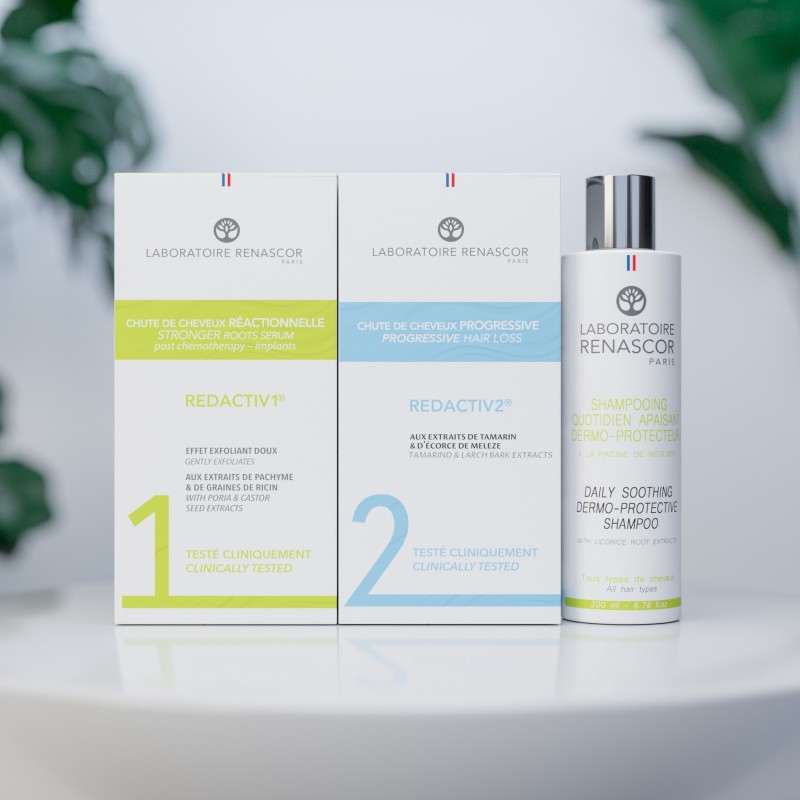
The RENASCOR protocol was designed to repair what chemotherapy has destroyed, at the very level of the bulb.
It acts simultaneously on the fundamental mechanisms of regrowth:
1. Reduction of inflammation (IL-6, IL-1β, TNF-α)
2. Reactivation of bulge stem cells
3. Reconstruction of internal and external sheaths
4. Stabilization of melanogenesis
5. Improvement of microvascularization
6. Normalization of the anagen cycle
7. Structural cohesion of the fiber (cuticle + cortex)
This is a molecular, targeted, clinical approach.
It does not nourish the hair.
It rebuilds the follicle.
6. The key point: in 4 months, the follicle is fully reconstructed
This is where the RENASCOR Laboratory protocol changes everything.
After 4 months:
-
stem cells function normally,
-
keratinization is restored,
-
inflammation is controlled,
-
pigmentation is stable,
-
the fiber regains its cohesion,
-
the anagen cycle regains its natural rhythm,
-
regrowth becomes perfectly normal.
Complete normalization occurs in 4 months, not 2 years.
Then time takes care of the rest. It can be supported or accelerated with REDACTIV2.
Thus, the pre-chemo texture returns without persistent anomalies.