


Stress & hair loss: what science really reveals
Stress is today one of the most underestimated factors in hair disorders. Yet its ability to disturb the hair cycle, the scalp vascularization and the activity of hair follicles is now clearly documented. For a person facing unexplained loss of density, understanding the link between stress and hair is the first step toward a coherent hair reconstruction.
1. Stress: a biological phenomenon, not just emotional
Contrary to popular belief, stress is not “just in the head”.
It triggers a real, measurable physiological cascade that profoundly alters internal balance:
-
Activation of the hypothalamic–pituitary–adrenal (HPA) axis
-
Secretion of cortisol
-
Activation of the sympathetic nervous system
-
Immune and inflammatory disruption
When this system is activated for a prolonged period, it directly impacts hair growth and health.
2. How does stress disrupt the hair cycle?
a) Cortisol shortens the growth phase (anagen)
The anagen phase is the period during which the hair actively grows.
However, a high cortisol level:
-
shortens this phase,
-
pushes the hair prematurely into the shedding (telogen) phase,
-
weakens keratin production.
This is how the fibre becomes thinner and density decreases.
b) Stress causes a telogen effluvium
Telogen effluvium is one of the most common consequences of stress.
It manifests as:
-
2 to 3 months after an acute stress,
-
as a diffuse, impressive but reversible shedding,
-
without patches or round zones.
If this effluvium lasts beyond 6 months, it can lead to lasting loss, notably in so-called androgen-sensitive areas (upper frontal and vertex).
c) Stress disrupts scalp micro-circulation
The vasoconstriction induced by stress reduces the supply of oxygen and nutrients:
-
the bulb operates at reduced speed,
-
local inflammation increases,
-
the produced fibre is thinner and less resilient.
The follicle then goes into survival mode, unable to maintain optimal growth.
3. Acute stress vs chronic stress: two very different impacts
Acute stress
An emotional shock can trigger a sudden, massive shedding:
➡️ telogen effluvium.
Good news: if acted on quickly, the synchronization of the hair cycle is restored rapidly.
Chronic stress
This is the most deleterious form. It leads to:
-
a progressive exhaustion of the follicle,
-
a slow miniaturization of the hair,
-
a loss of density that can persist as long as the stress continues.
4. Why do some people lose more hair than others under stress?
Because sensitivity to stress depends on many parameters:
-
genetics and hormonal predispositions,
-
sleep quality,
-
nutrition,
-
duration and intensity of the stress,
-
immune status and microbiome,
-
lifestyle (pollution, smoking, overwork…).
The same stress never produces the same effects in two individuals.
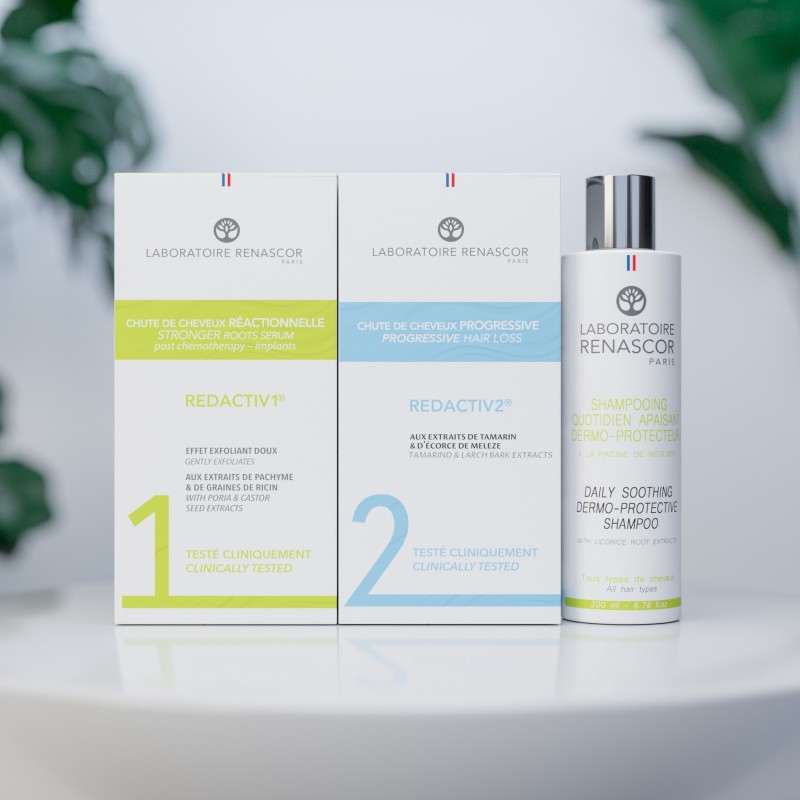
5. What role do RENASCOR treatments play in stress-related shedding?
Stress-related shedding is mostly a telogen effluvium.
This type of shedding is reversible, if the biology of the bulb is restored.
RENASCOR treatments act on:
-
the restart of follicular metabolism,
-
the normalization of the hair cycle,
-
the improvement of micro-vascularization,
-
the reduction of inflammation and oxidative stress,
-
the progressive reconstruction of the fibre.
It is in this context — stress + diffuse hair loss — that results are often the fastest and most visible.
FAQ – Stress and hair loss
1. Can stress cause lasting hair loss?
Yes. Acute stress causes temporary shedding, but chronic stress can durably disrupt bulb biology and lead to progressive thinning, especially in hormone-sensitive areas (vertex and upper frontal).
2. How long after a stress event does shedding appear?
On average 2 to 3 months after the stressful event. This is the classic signature of telogen effluvium, linked to a premature entry into the shedding phase.
3. Can you regain your initial density after stress-related shedding?
Yes, in the majority of cases. The follicle is not destroyed: it is inhibited.
With a coherent reconstruction protocol, regrowth is generally very visible.
4. Can chronic stress mimic hormonal shedding?
Absolutely. Hair thins, density decreases, especially at the top of the scalp.
Therefore the two must be distinguished through a precise diagnosis and an analysis of the life context.
5. Are RENASCOR treatments suitable for stress-related shedding?
Yes. Telogen effluviums related to stress respond particularly well to the RENASCOR protocol, because the bulb biology can be restarted quickly.
Results are often visible within the first weeks.