

Can you dye your hair after chemotherapy?
\nThe complete and safe guide from RENASCOR Laboratory
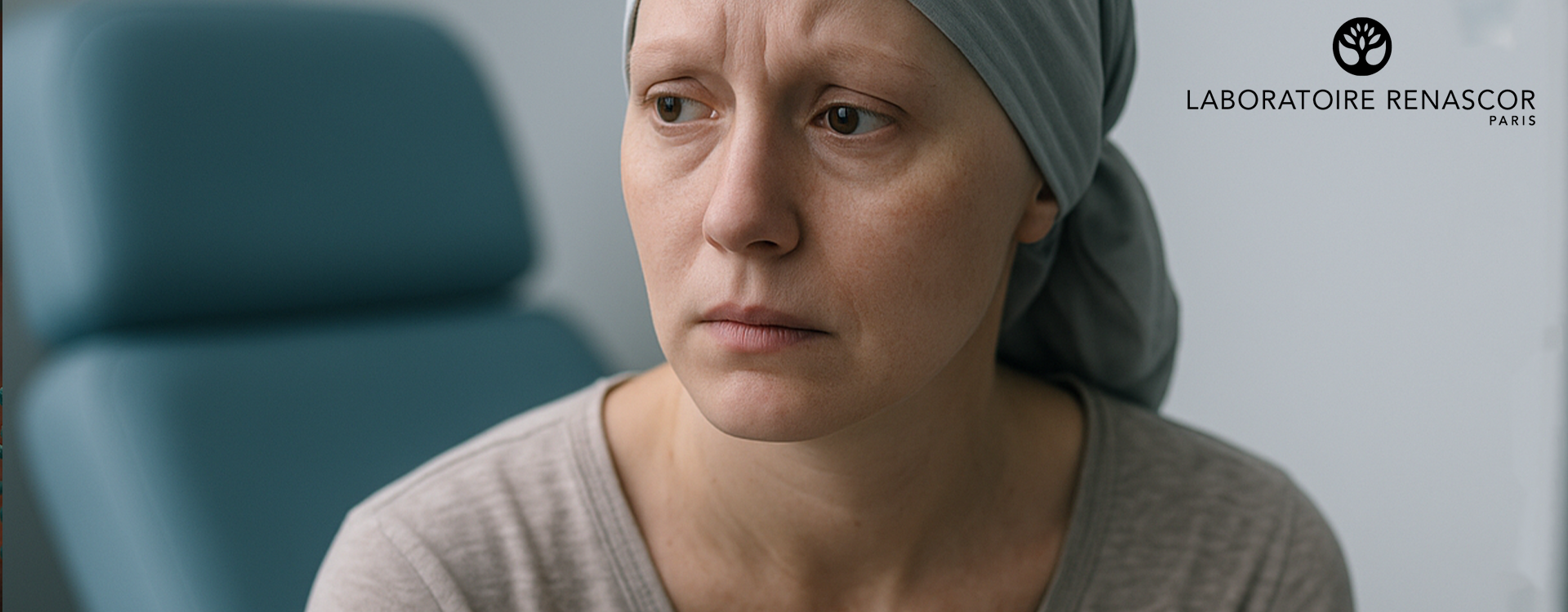
\nThe regrowth of hair after chemotherapy marks a symbolic moment: the one where you find your reflection, your identity, your strength.
Very quickly, a question arises: “Can I dye my hair?”
The answer is neither an automatic “yes” nor a categorical “no”. It depends on the biology of the scalp, the type of treatment received, and the stage of recovery.
Here is the reference, clear, reassuring, based on the scientific expertise of RENASCOR Laboratory, the world's leading specialist in post-cancer hair reconstruction.
Why is dyeing a sensitive act after chemotherapy?
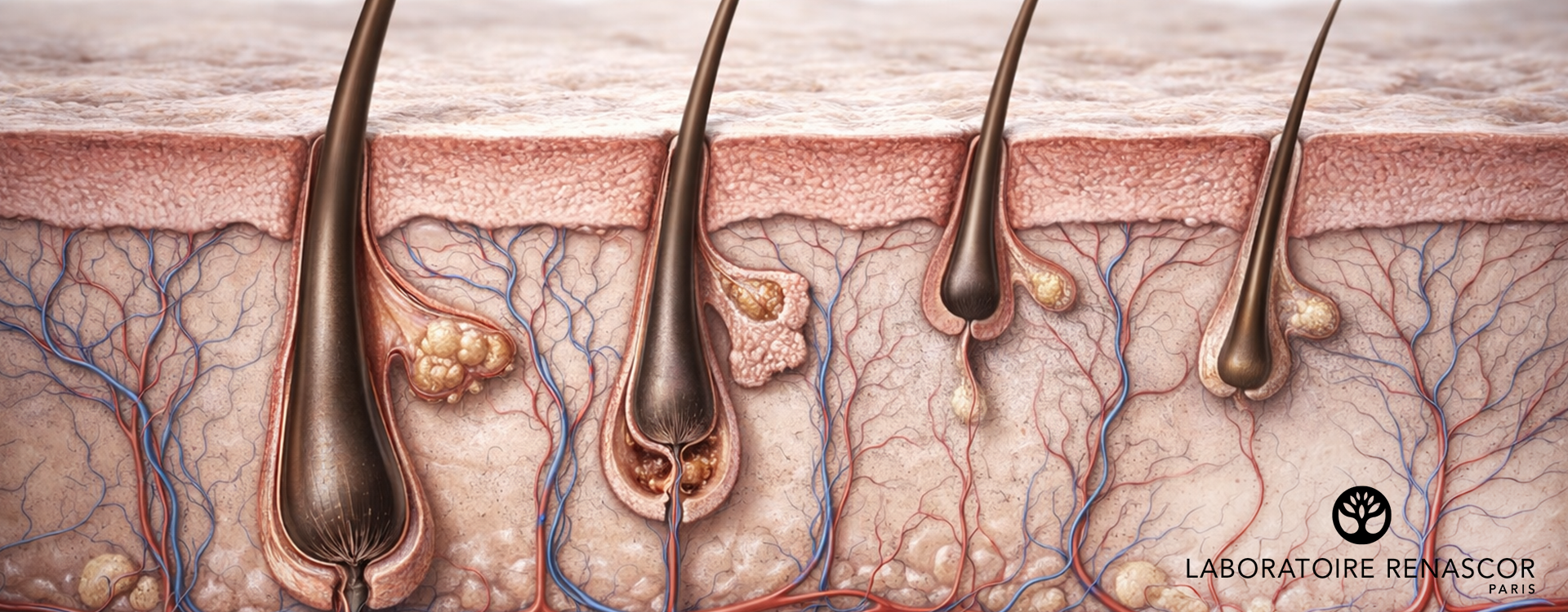
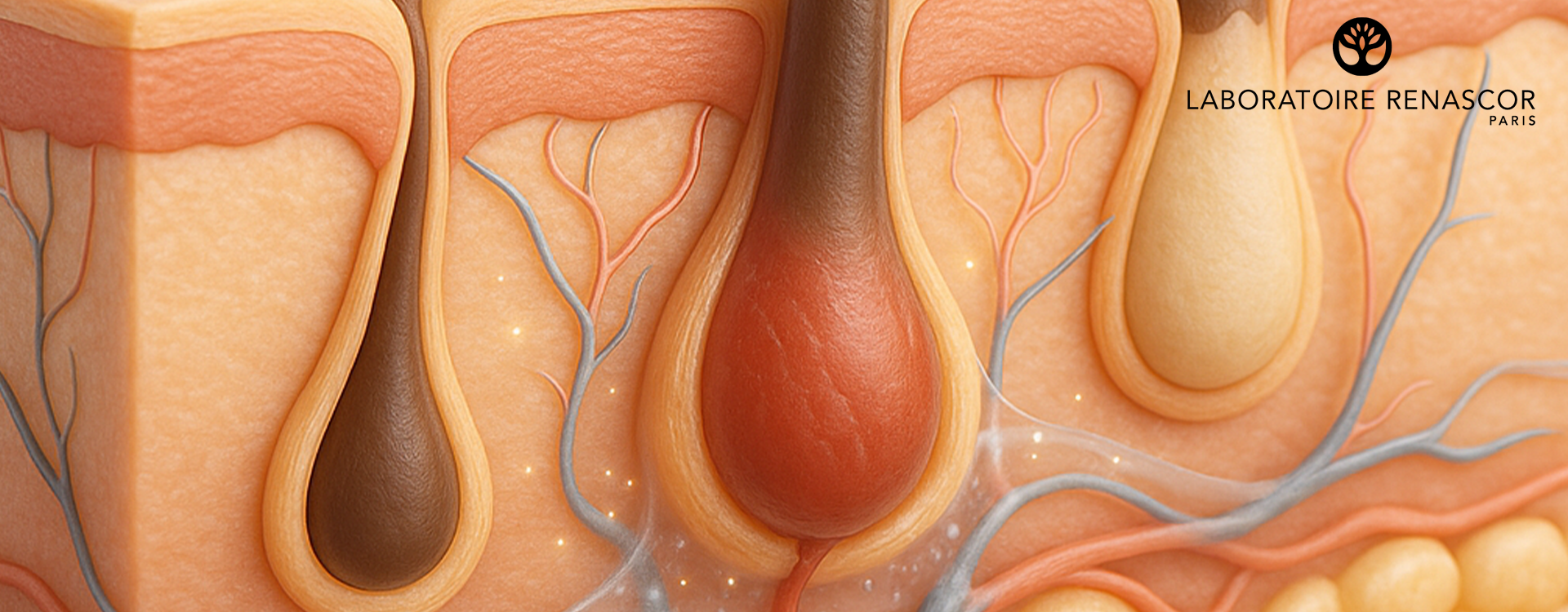
\nChemotherapy targets rapidly renewing cells. Among them are hair follicles.
Even when hair begins to regrow, the scalp and hair fiber remain weakened for several months.
A scalp more reactive than usual
\nAfter treatment, we often observe:
\n- \n
- \n
a damaged skin barrier
\n \n - \n
an increased sensitivity to chemical agents
\n \n - \n
persistent dryness
\n \n - \n
residual micro-inflammations
\n \n
This sensitivity radically changes how the scalp tolerates dyes.
\nAn immature hair fiber
\nThe first centimeters of regrowth have very specific characteristics:
\n- \n
- \n
poorly consolidated keratin
\n \n - \n
irregular thickness
\n \n - \n
modified textures (post-chemo waves)
\n \n - \n
weak mechanical resistance
\n \n
Before exposing this fiber to an oxidizer, it is essential to wait for its structure to stabilize.
\nPotentially aggressive coloring agents
\nEven so-called “gentle” dyes can contain irritating molecules for a post-oncological scalp:
\n- \n
- \n
PPD
\n \n - \n
resorcinol
\n \n - \n
peroxides
\n \n - \n
alkaline salts
\n \n
That’s why waiting periods are essential.
\nHow long should you wait before dyeing?
\nRecommendations vary depending on the treatment, but the principle remains constant: protect the recovering scalp.
\nAfter conventional chemotherapy
\n→ Wait 3 to 6 months after the end of treatments.
This delay allows:
- \n
- \n
the gradual restoration of the skin barrier
\n \n - \n
the appearance of a more resilient fiber
\n \n - \n
a decrease in the risk of hypersensitivity
\n \n
After immunotherapy or targeted therapy
\n→ Wait about 6 months, especially if scalp irritations have been observed.
These therapies can prolong skin hyperreactivity.
After skull radiotherapy
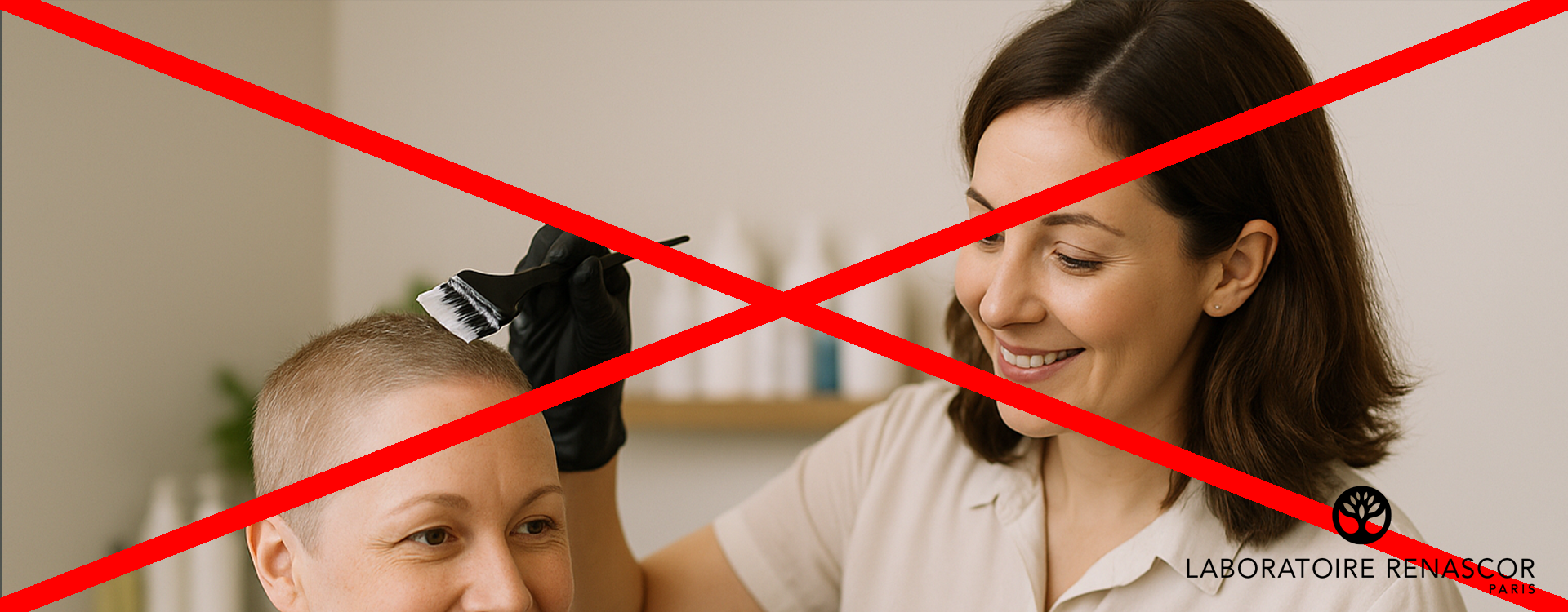
\n→ Special case: dyeing is only feasible when:
\n- \n
- \n
the regrowth is no longer painful
\n \n - \n
the scalp is no longer inflamed
\n \n - \n
the density begins to stabilize
\n \n
The time frame varies between 6 and 18 months depending on the area and intensity of treatment.
\nWhat types of dye are most suitable post-chemo?
\nHere is the safest tolerance order:
\nPlant-based dyes (dye plants, henna, indigo)
\nThey:
\n- \n
- \n
do not contain oxidizer
\n \n - \n
coat the fiber instead of penetrating it
\n \n - \n
visually strengthen volume
\n \n - \n
are best suited for a first return to dyeing
\n \n
A skin test remains essential.
\nAmmonia-free tone-on-tone dyes
\nThey have:
\n- \n
- \n
low penetration
\n \n - \n
good tolerance
\n \n - \n
a more natural finish
\n \n - \n
little risk of irritation if the scalp is healthy
\n \n
Permanent oxidative dyes
\nTo be avoided during the first months because:
\n- \n
- \n
they penetrate deeply into the fiber
\n \n - \n
they require alkaline agents
\n \n - \n
they can cause redness and irritation
\n \n
They should only be considered after complete stabilization of the regrowth.
\nEssential safety rules
\nWhether the dye is plant-based or tone-on-tone, certain precautions are non-negotiable.
\n1. Allergy test 48 hours prior
\nThe immune system may react differently after treatment.
Even a product used before cancer may become irritating.
2. Assessment of the scalp before each dyeing
\nThe procedure should be immediately postponed in case of:
\n- \n
- \n
itching
\n \n - \n
redness
\n \n - \n
scaling
\n \n - \n
painful areas
\n \n - \n
hypersensitivity
\n \n
3. Application only on dry scalp
\nA wet scalp absorbs more chemical agents.
\n4. Reduction of the exposure time
\nNever exceed the recommended minimum during the first months.
\n5. Use of a protective barrier
\nThick oils or creams to avoid direct contact on sensitive areas.
\nWhy go through a professional trained in oncology?
\nBecause post-chemotherapy dyeing is not a trivial aesthetic act.
\nSocio-aestheticians and specialized colorists know:
\n- \n
- \n
how to analyze the real condition of the scalp
\n \n - \n
identify contraindications
\n \n - \n
use the mildest dyes available
\n \n - \n
adjust exposure times
\n \n - \n
offer elegant alternatives (glosses, light reflections, non-oxidizing gloss)
\n \n
Their role is crucial to avoid inflammatory reactions… and to gently accompany the return to hair pleasure.
\nWhat alternatives if dyeing still has to wait?
\nDuring weeks when the scalp remains too sensitive, several safe options exist:
\n- \n
- \n
light glosses
\n \n - \n
plant-based glosses
\n \n - \n
temporary color sprays
\n \n - \n
mineral powders
\n \n - \n
non-oxidizing highlights
\n \n - \n
protective hairstyles
\n \n - \n
elegant aesthetic accessories
\n \n
These allow you to feel better without compromising recovery.
\nConclusion: yes, but never too early, and always with caution
\nYes, you can dye your hair after chemotherapy.
But only when the biology is ready.
The essential rules:
\n- \n
- \n
wait at least 3 to 6 months
\n \n - \n
favor plant-based or very gentle dyes
\n \n - \n
systematically assess the scalp
\n \n - \n
avoid any oxidizer at the beginning
\n \n - \n
consult a professional trained in oncology
\n \n
After cancer, the goal is not just to dye:
it is to rebuild, protect, and support a durable and healthy regrowth.
\n
FAQ
\n1. When can I do my first dye after chemotherapy?
\nMost patients can consider dyeing between 3 and 6 months after the end of chemotherapy, provided the scalp is healthy, not irritated, and the regrowth is stabilized. Each case remains individual.
\n2. Can dyeing damage hair regrowing after cancer?
\nYes, if done too early or with aggressive oxidative agents. Post-chemo hair is more fragile: its keratin is immature and the scalp remains highly reactive. Hence the importance of waiting, being accompanied, and choosing a gentle method.
\n3. What type of dye is safest after chemotherapy?
\nPlant-based dyes are the best tolerated: they coat the fiber without penetrating it and respect the scalp.
Gentle tone-on-tone dyes can be suitable afterwards, while oxidative permanent dyes should be avoided in the first months.
4. Is plant dye really risk-free?
\nIt is the gentlest method, but it still requires a 48-hour allergy test. After cancer, the immune system can react differently. Vigilance remains essential.
\n5. Can one dye hair if the scalp is still sensitive?
\nNo.
Redness, itching, scaling, or pain are absolute contraindications. The scalp must be perfectly soothed before any dyeing.
6. Can chemotherapy change the natural color of new hair?
\nYes, it is common.
Hair can regrow:
- \n
- \n
darker
\n \n - \n
lighter
\n \n - \n
gray or salt and pepper
\n \n - \n
with a different texture (curly, wavy)
\n \n
This change is generally temporary, but can last for several hair cycles.
\n7. Is it mandatory to go to a specialized salon for post-chemo dyeing?
\nIt is not mandatory, but it is strongly recommended.
Socio-aestheticians and colorists trained in oncology master:
- \n
- \n
the assessment of the scalp,
\n \n - \n
the least irritating techniques,
\n \n - \n
temporary alternatives,
\n \n - \n
the precautions adapted to post-chemotherapy regrowth.
\n \n
8. Can one bleach hair after cancer?
\nBleaching is the most aggressive act for the scalp.
It is not recommended in the first months and should only be considered after a professional evaluation and a fully stabilized regrowth.
9. Can color sprays or hair powders be used during regrowth?
\nYes.
Temporary solutions are interesting because:
- \n
- \n
they do not penetrate the fiber,
\n \n - \n
they do not require any oxidizer,
\n \n - \n
they wash out with shampoo.
\n \n
They represent an elegant alternative while waiting for the first real dyeing.
\n10. Should I do an allergy test even if I use the same dye as before my cancer?
\nYes, absolutely.
Treatments can change skin and immune reactivity.
All specialized oncology laboratories recommend a systematic test.
11. Can one dye hair while still on hormone therapy?
\nYes, in most cases, but always with gentle dyes and only if the scalp is stable.
Hormone therapy does not prevent dyeing, but may maintain some sensitivity.
12. Why are my hair curlier after chemotherapy?
\nIt is a well-known phenomenon: chemotherapy temporarily alters the structure of the hair follicle.
The “post-chemo hair” can be wavy, curly, thicker, or thinner.
This texture may return to normal over a few hair cycles.
13. Can I dye my hair if I had skull radiotherapy?
\nNot as long as:
\n- \n
- \n
the irradiated areas remain sensitive,
\n \n - \n
the regrowth is sparse or painful,
\n \n - \n
the skin shows redness.
\n \n
Depending on the cases, resumption may take 6 to 18 months.
\n14. Can dyeing slow down regrowth?
\nNo, dyeing does not affect the speed of regrowth, but it can cause a reactive fall if it strongly irritates the scalp.
Hence the importance of waiting for complete biological restoration.
15. What are the first signs that dyeing is poorly tolerated?
\nDuring or after application:
\n- \n
- \n
burning sensations
\n \n - \n
intense tingling
\n \n - \n
persistent itching
\n \n - \n
redness
\n \n - \n
plaques or scabs
\n
→ Rinse immediately and consult if necessary. \n