


La socio-coiffure en oncologie : the profession, the training, the support.
Understanding socio-hairdressing and socio-aesthetics in oncology, their place in supportive care and the training of professionals.
Socio-hairdressing in oncology is a hair care practice for people affected by cancer, integrated into supportive care. The socio-hairdresser adapts the hairdressing procedure to the patient's fragility - hair loss, sensitized scalp, regrowth - in addition to the healthcare team, in a posture of listening and respecting an ethical framework.
Socio-hairdressing in oncology supports patients with the loss and regrowth of their hair, in addition to medical care. It is linked to socio-aesthetics, which often intervenes earlier in the course and influences patients' choices. These professions require specific training, combining technique, knowledge of hair physiopathology and supporting posture. The RENASCOR Laboratory contributes to this transmission through the interventions of its founder, Stéphane Paulet, in training centers, supportive care webinars and international conferences. This page defines the professions, their place in the course and the training challenges.
Socio-hairdressing in oncology is hair support for patients with cancer by a trained professional, in addition to the healthcare team. It helps to prepare for, experience and overcome hair loss, and to support regrowth. Distinct but complementary to socio-aesthetics, it falls under supportive care and requires dedicated training covering technique, hair physiopathology and the relationship with the patient.
Qu'est-ce que la socio-coiffure ?
Socio-hairdressing is a hairstyle adapted to people weakened by illness, old age or a situation of vulnerability. In oncology, she specifically supports patients faced with hair loss linked to treatments, then their regrowth.
The socio-hairdresser is not satisfied with a technical gesture: he takes into account the condition of the scalp, the moment of the treatment course, and the emotional charge attached to the hair. His role is as much about listening as it is about know-how. It works in institutes, at home, or within health establishments, always in addition to – never as a replacement – medical care.
- Socio-hairdressing adapts the hairdressing gesture to the patient's fragility.
- En oncologie, elle accompagne la perte puis la repousse des cheveux.
- She complements the healthcare team, never in its place.
Socio-hairdressing and socio-aesthetics: two complementary professions
Socio-hairdressing and socio-aesthetics share the same vocation — supporting the sick person beyond medical care — but involve different gestures. One takes care of hair and scalp, the other takes care of skin and aesthetic care. Far from opposing each other, they complement each other throughout the journey.
One point is essential to understand: the socio-beautician often intervenes earlier than the socio-hairdresser, sometimes from the start of the treatments. She is frequently the first wellness professional the patient meets. As such, she plays a decisive information and guidance role: her advice influences the patient's choices for the future, including hair support.
| Criteria | Socio-coiffure | Socio-aesthetics |
|---|---|---|
| Objet du soin | Cheveux, cuir chevelu | Peau, visage, modelages |
| Special moment | During and especially after treatment | Often from the start of treatment |
| Key role | Accompanying loss and regrowth | Well-being, early information, guidance |
Cranial modeling et le choix du soin
Among the gestures that socio-estheticians practice is cranial massage: a gentle massage of the scalp, appreciated for its soothing and relaxing effect in often distressed patients. However, this procedure is carried out precisely on a scalp weakened by treatments — sensitive, sometimes inflammatory.
The choice of massage support treatment is therefore not neutral. On a scalp coming out of chemotherapy, a treatment designed for this area is preferable to a standard cosmetic product. The REDACTIV 1 serum, formulated with 99% natural origin to repair and soothe weakened scalp, is suitable for this use: it accompanies the gesture while respecting the sensitivity of the area. Discover REDACTIV 1.
For the socio-esthetician, integrating good care into cranial massage means consistency and quality: a gesture of well-being that takes care of the area rather than simply gliding over the skin. This treatment does not constitute a treatment and does not guarantee results in regrowth; it accompanies the gesture on a scalp that requires gentleness.
- Cranial modeling is carried out on a scalp weakened by treatments.
- A treatment designed for this terrain is preferable to a standard product.
- REDACTIV 1 accompanies this gesture while respecting the sensitivity of the scalp.
La place du professionnel in the care team
The hair and aesthetic support professional is part of supportive care: all of the care that improves the quality of life during and after cancer, in addition to treatments. Its role requires clear communication with caregivers and compliance with a strict ethical framework.
Concretely, this means never encroaching on the medical field, directing towards the healthcare team in case of doubt, and providing support without making any promise of results. This rigor in posture is what distinguishes professional support from a simple well-being service.
Training in socio-hairdressing: la Soco Academy
Accompanying patients in oncology cannot be improvised. Beyond technical mastery, the job requires knowledge of the pathophysiology of induced alopecia and regrowth, and a listening posture adapted to the vulnerability of people. Dedicated training is essential.
The Soco Academy, present in Anglet, Lyon and Paris, trains professionals in socio-hairdressing. Stéphane Paulet, founder of the RENASCOR Laboratory, regularly intervenes there to convey the “laboratory” vision of the profession: understanding the biology of hair and scalp before acting, and choosing the treatments adapted to each situation. His interventions present the RENASCOR approach — restoring the ground before stimulating — and the proper use of the range in professional practice.
- Socio-hairdressing in oncology requires dedicated, technical and relational training.
- The Soco Academy trains professionals in Anglet, Lyon and Paris.
- Stéphane Paulet transmits the “laboratory” vision and the proper use of care.
Stéphane Paulet, une expertise reconnue dans les soins de support
The RENASCOR Laboratory's commitment to transmission is not limited to initial training. Its founder, Stéphane Paulet, is an active figure in the supportive care ecosystem, at several levels.
He hosts webinars bringing together leading supportive care professionals — from field practitioners to institutions, including the National Federation of Socio-Aestheticians (FNSE). These meetings allow us to share clinical practices, field observations and visions of the profession, and establish dialogue between the disciplines of support.
He also speaks as an expert at international conferences, particularly in the countries of the Commonwealth of Independent States (CIS), where he presents the spirit and knowledge of the RENASCOR Laboratory. These speeches help to disseminate a scientific and caring approach to hair reconstruction beyond borders.
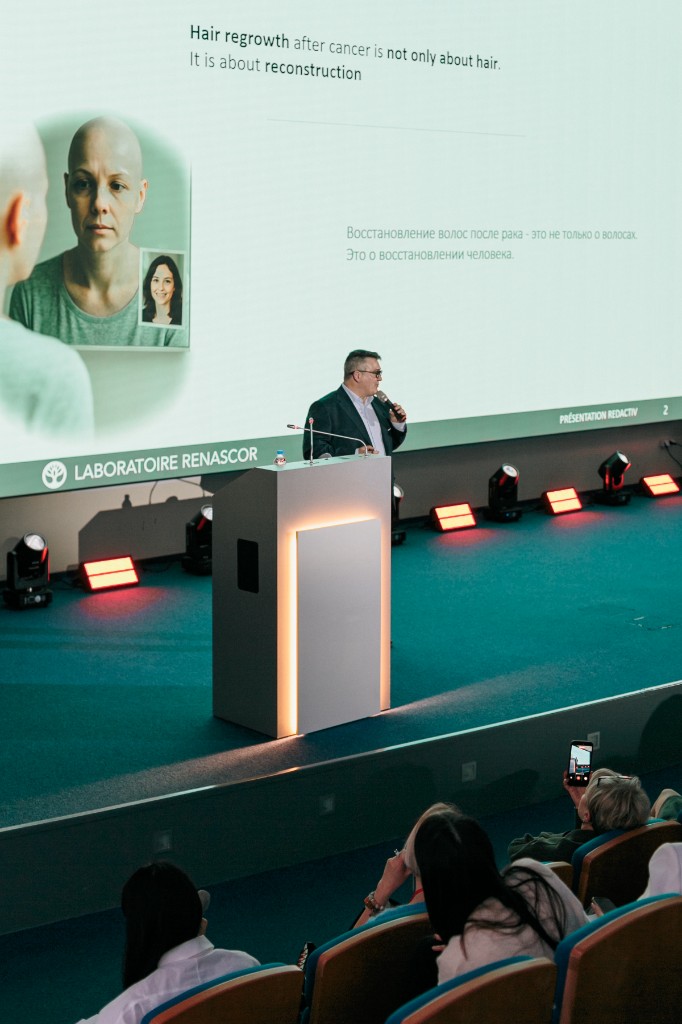
- Stéphane Paulet hosts supportive care webinars, from practitioner to institution (FNSE).
- Il intervient comme expert dans des colloques internationaux, notamment dans les CIS.
- These commitments anchor Laboratoire RENASCOR in the supporting care ecosystem.
Pourquoi une approche “laboratory” of socio-hairdressing
The specificity of the approach defended by the RENASCOR Laboratory is due to a shift in perspective: considering the scalp not as a simple surface to be styled, but as a biological terrain on which the quality of regrowth depends. This is what the principle “we rebuild before we stimulate” sums up.
For the professional, adopting this approach changes the practice: choosing treatments adapted to a weakened scalp, understanding the stages of regrowth to support without promising, and integrating your action into a logic of field care. It is this culture that the training transmits and that Stéphane Paulet's interventions carry.
Integrate these professionals in a healthcare facility
More and more establishments — oncology departments, supportive care units, health homes, associations — are integrating socio-hairdressers and socio-beauticians into their support offering. This integration meets strong patient expectations and is part of a global approach to care.
For an establishment, welcoming these professionals requires certain benchmarks: clearly defining their scope in relation to medical care, choosing workers trained in the specificity of oncology, and ensuring the quality of care used on vulnerable patients. This is precisely where a “laboratory” approach – understanding the field before acting, choosing appropriate care – provides a guarantee of seriousness.
The RENASCOR Laboratory supports this approach by training professionals and providing treatments designed for weakened scalps, while respecting the framework of supportive care.
- Establishments are increasingly integrating these professionals into supportive care.
- Integration requires a clear perimeter, trained stakeholders and appropriate care.
- The “laboratory” approach provides a guarantee of seriousness for vulnerable patients.
Frequently asked questions
What is the difference between a hairdresser and a socio-hairdresser?
The socio-hairdresser adapts his practice to vulnerable people – here, oncology patients – and integrates a dimension of support and listening, linked to the care pathway. He complements the healthcare team.
What is the difference between socio-hairdressing and socio-aesthetics?
The two professions support the sick person beyond medical care, but with different gestures: hair and scalp for socio-hairdressing, skin and modeling for socio-aesthetics. The socio-esthetician often intervenes earlier in the process.
What treatment should I use for cranial massage after chemotherapy?
On a weakened scalp, a treatment designed for this area is better than a standard cosmetic product. The REDACTIV 1 serum, 99% of natural origin, is formulated to repair and soothe the scalp after chemotherapy and accompanies this procedure while respecting its sensitivity.
How to train in socio-hairdressing in oncology?
Through dedicated training covering technique, hair physiopathology and accompanying posture. The Soco Academy (Anglet, Lyon, Paris) trains professionals; Stéphane Paulet, founder of the RENASCOR Laboratory, transmits the “laboratory” vision of the profession and the proper use of care.
Does socio-hairdressing replace medical care?
No, never. It relates to supportive care and complements treatments, in compliance with an ethical framework. The professional directs the care team in case of doubt and makes no promise of results.
This guide is published by the Laboratoire RENASCOR Paris, a French cosmeceutical laboratory specializing in hair reactivation and reconstruction since 2017, and its founder Stéphane Paulet, a recognized trainer and stakeholder in the supportive care ecosystem. Our approach is based on a principle: we rebuild before stimulating. Discover our scientific approach and our sources.
Pour aller plus loin
This page is intended for information. It does not replace any medical advice and does not constitute an individual promise of results. Information on training centers and interventions is provided by the RENASCOR Laboratory and must be kept up to date. The name and logo of Soco Academy and FNSE belong to their respective owners; their mention implies their agreement.